Materials Engineering · Optical Physics · Research
IR and UV for CO₂ Polariton Photocatalysis
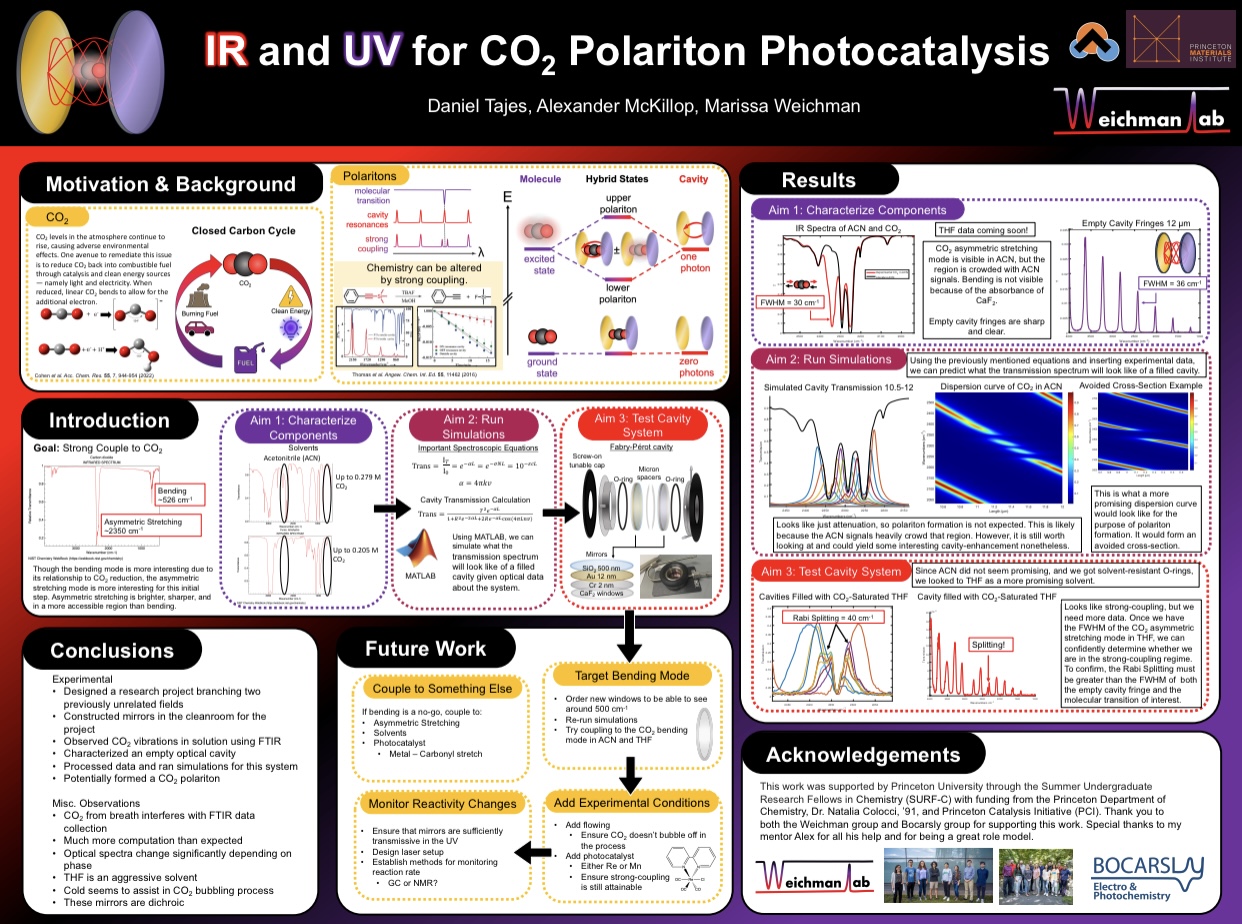
Targeting CO₂ vibrational modes as candidates for light-matter strong coupling — using standing IR waves in an optical cavity to affect UV-induced photoreduction.
Strong Coupling & Polaritons
When light and matter interact strongly enough, they form hybrid quantum states called polaritons. In this strong coupling regime, the properties of the matter — including its chemical reactivity — can be modified by the light field it is coupled to. This opens the possibility of controlling chemical reactions using photonic structures rather than chemical modification.
An optical cavity — two highly reflective mirrors facing each other — can confine light long enough to achieve this strong coupling with molecules placed between the mirrors. The geometry and spacing of the cavity determines which photon modes are supported and therefore which molecular modes can be coupled.
CO₂ Vibrational Coupling
CO₂ has characteristic vibrational modes in the infrared (IR) — the asymmetric stretch at ~2349 cm⁻¹ is the primary target for strong coupling experiments. By constructing an optical cavity that supports standing IR wave modes resonant with CO₂ vibrational frequencies, and placing CO₂ or CO₂-containing systems between the mirrors, we aimed to achieve vibrational strong coupling.
The hypothesis: if CO₂ vibrational modes are strongly coupled to the cavity field, the modified energy landscape of the polariton states could affect the pathway and rate of subsequent UV-induced photoreduction reactions — potentially enabling more selective or efficient CO₂ conversion.
Experimental Approach
My work involved constructing and characterizing optical cavities, preparing CO₂-relevant samples for strong coupling experiments, measuring IR transmission spectra to verify coupling, and running UV photocatalysis experiments under both coupled and uncoupled conditions to detect any modification of reactivity by the cavity.